In the world of fluid power, external aesthetics are secondary to internal performance. However, as any seasoned mechanical engineer knows, the two are often intrinsically linked. A specific surface finish isn’t just about looking good; it is often a functional requirement for coating adhesion or seal integrity.
At Rapid Model, we see thousands of designs pass through our shop floor in Shenzhen, but few components demand the rigorous attention to detail required by CNC machined hydraulic manifolds.
In this post, I want to break down a specific component we recently manufactured (pictured above). We will analyze the visible features that indicate quality machining and dive into the invisible challenges—specifically internal cross-drilling and deburring—that determine whether a hydraulic system fails or functions.
Table of Contents
- Visual Analysis: More Than Just a Block of Metal
- The Hidden Engineering: Cross-Drilling and Flow Paths
- The Silent Killer: Internal Deburring
- Surface Finishing for Functionality
- Why Rapid Model for Fluid Power Components?
Visual Analysis: More Than Just a Block of Metal
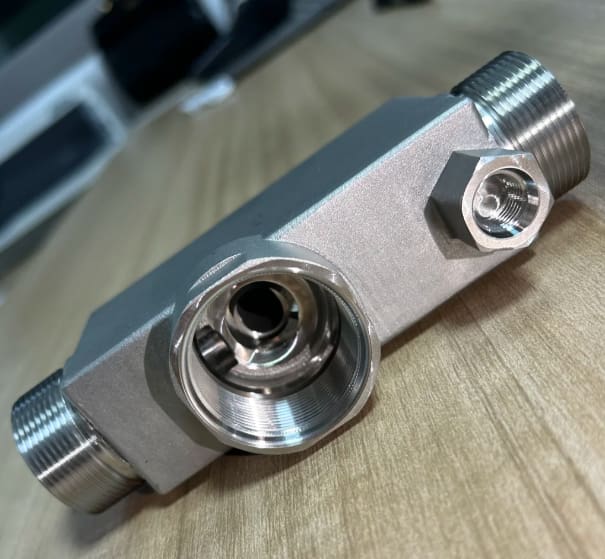
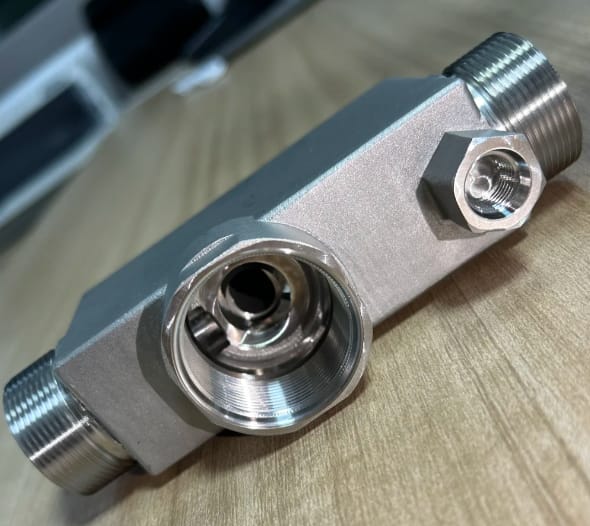
Let’s look closely at the image of the manifold block provided. To the untrained eye, it is a simple machined component. To a procurement manager or an engineer, the details tell a story of precision.
The part appears to be machined from Aluminum 6061-T6, a standard choice for medium-pressure hydraulic applications due to its excellent strength-to-weight ratio and machinability.
Key Features Observed:
- External Threaded Ports: The two ends feature male threads, likely NPT or BSPT. The thread crests are clean, indicating sharp tooling and correct feed rates during the turning or threading operation.
- Spot Facing: Look at the large side port. The flat area surrounding the internal thread is the “spot face.” This surface must be perfectly perpendicular to the thread axis. If this surface has a poor Ra (Roughness Average) or is not flat, the washer or O-ring will not seal, leading to immediate leaks under pressure.
- Hexagonal Boss: The machined hex feature suggests this port may need to be torqued or held with a wrench during assembly, requiring precise milling to standard wrench sizes.
To achieve these geometries, we utilize advanced CNC machining services, often employing 4-axis or 5-axis mills to reach multiple sides of the block without re-fixturing, which guarantees better concentricity between the ports.
The Hidden Engineering: Cross-Drilling and Flow Paths
The caption of the social media post hit the nail on the head: “The real magic happens in the intersecting cross-drills hidden within.”
A manifold is essentially a logic circuit for fluid. It directs flow from pumps to actuators. This requires drilling long, straight holes that intersect deep inside the block.
The Machining Challenges:
- Drill Drift: When drilling deep holes (where depth > 10x diameter), the drill bit tends to wander. If the drill deviates even slightly, it might miss the intersecting hole or break through the wall of the manifold, scrapping the part.
- Blind Intersections: The machinist cannot see where the channels meet. We rely on precise CNC programming and probe verification to ensure the fluid path is open and unrestricted.
- Turbulence: If the intersection of two drills is offset, it creates a “step” inside the flow path. This creates turbulence, heat, and pressure drops, reducing the efficiency of your hydraulic system.
For complex manifolds, we often recommend rapid prototyping in clear acrylic (PMMA) or a soft metal first. This allows engineers to visually verify the flow paths and check for design errors before committing to a production run in expensive stainless steel or aluminum.
The Silent Killer: Internal Deburring
The most dangerous defect in a hydraulic manifold is the one you cannot see. When a drill bit breaks through into an intersecting hole, it leaves a “hanging burr” or a cap of metal.
If this burr is not removed, the hydraulic fluid will eventually break it loose during operation. That jagged piece of metal will travel downstream until it destroys a pump, jams a solenoid valve, or scores a cylinder wall.
How We Verify Cleanliness
At Rapid Model, “visual inspection” isn’t enough for internal geometries. We employ:
- Borescopes: Utilizing fiber-optic cameras to inspect the intersections deep inside the block.
- Thermal Deburring: For high-volume production, we utilize thermal energy to vaporize burrs instantly without affecting the dimensions of the part.
- Manual Picking: For precision prototypes, our skilled technicians use specialized hooked tools under magnification to manually remove burrs from critical intersections.
Surface Finishing for Functionality
The image shows a distinct, uniform matte grey texture. This is the result of bead blasting.
While bead blasting looks professional, in this context, it serves a technical purpose. As noted in the post, this surface prep is crucial for subsequent operations. If this part is destined for Anodizing (Type II or Type III Hard Coat), the bead blasted surface increases the surface area, allowing the anodic layer to bond more effectively.
Furthermore, bead blasting removes minor tool marks, providing a uniform non-directional finish that hides handling scratches during assembly.
However, masking is critical here. You will notice the threads in the image are bright and shiny, while the body is matte. We must precisely plug or mask all threaded ports and sealing surfaces (like that spot face) before blasting. If we blast the sealing face, we ruin the surface tolerance required for the seal.
For a deeper dive into how we manage textures and coatings, visit our Surface Finishing page.
Why Rapid Model for Fluid Power Components?
Sourcing hydraulic components from China requires trust. You need a partner who understands that a manifold isn’t just a block with holes—it’s a pressure vessel.
At Rapid Model, we combine ISO 9001 quality management with the speed of Shenzhen manufacturing.
- Material Certification: We provide full material certs (Mill Test Reports) to prove the aluminum or steel grade can handle your pressure ratings.
- Precision Equipment: Our 5-axis Mazak and Haas machines ensure tight geometric tolerances on complex angles.
- Global Standard Threads: Whether you need NPT (USA), BSPP (Europe/UK), or Metric threads, we have the gauging and tooling to ensure perfect fitment.
Don’t let internal burrs or poor surface sealing compromise your hydraulic systems.