In the world of custom manufacturing, we spend hours optimizing toolpaths, calculating feeds and speeds, and chasing tolerances down to the micron. But as a Senior Sales Engineer here in Shenzhen, I have seen too many projects from other vendors fail not because of the machining, but because of what happens after the part leaves the machine.
You can machine a flange to within +/- 0.005mm, but if that part is tossed loosely into a box and shipped across the ocean to a warehouse in Germany or the USA, it will arrive as scrap.
[TOC Placeholder]
Visual Analysis: More Than Just a Metal Disc
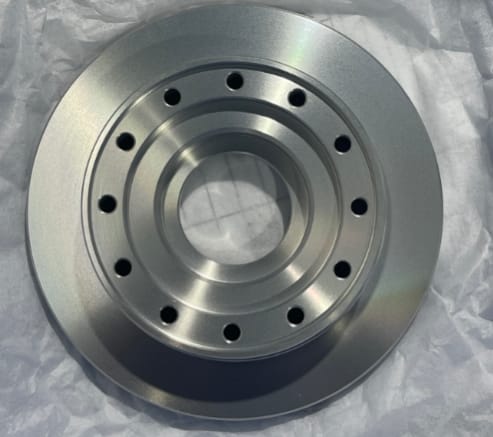
Let’s look closely at the image provided above. This isn’t just a generic “metal circle”; it is a high-precision mechanical interface. Based on the visual evidence, here is a technical breakdown of what we are looking at:
- Geometry: This is a turned flange or mounting hub, likely featuring a central bore for a shaft or bearing assembly.
- Features: It features a bolt circle (PCD) with approximately 10-12 counterbored or countersunk holes. The concentricity between the outer diameter (OD), the bolt circle, and the inner bore is likely critical for assembly alignment.
- Material & Finish: The part appears to be Aluminum 6061-T6 or perhaps 7075. The surface has a uniform, satin texture, suggesting it has undergone a light bead blast followed by Clear Anodizing (Type II).
The Machining Challenge
Producing this part requires our CNC machining services to utilize multi-axis turning centers. The primary challenge here is maintaining flatness on the mating face while ensuring the bolt holes are perfectly indexed. If the face isn’t perfectly flat (often requiring Ra 0.8 or better), the assembly won’t seal or mount flush.
The Hidden Risk: Surface Finish Integrity
Why is the packaging paper in the photo so important?
When dealing with precision CNC turned parts, specifically those with cosmetic or functional surface treatments, “part-on-part contact” is the enemy. Aluminum, while having an excellent strength-to-weight ratio, is relatively soft compared to steel.
If two of these flanges were to vibrate against each other during air freight or sea shipping:
- Fretting Corrosion: Micro-vibrations cause surface asperities to weld and tear, ruining the finish.
- Anodize Chipping: While anodizing hardens the surface, sharp edges can still chip if impacted, exposing the raw aluminum to oxidation.
- Dimensional Loss: A ding on the sealing face or the rim of the bore can throw the part out of tolerance, rendering it useless for high-precision applications.
This is why we treat industrial components like jewelry.
What Buyers Should Verify
Before placing an order, confirm material grade, tolerance-critical features, inspection methods, finishing limits, packaging, lead time, and applicable certifications with the selected manufacturing partner. SP Precision coordinates RFQ review, DFM communication, quotation, and supplier follow-up; project-specific production capabilities and certification documents are confirmed before order placement.
1. Deburring and Cleaning
Before any packaging happens, the part must be free of burrs. We use manual deburring and tumbling techniques to break sharp edges. Following this, ultrasonic cleaning removes coolant residues. If coolant is left on the part inside a sealed bag, it can cause chemical staining during transit.
2. Surface Finishing Verification
As seen in the image, the finish is flawless. Whether it’s bead blasting, anodizing, or powder coating, our surface finishing department inspects the cosmetic quality under standardized lighting conditions. We check for consistent texture and color uniformity.
3. The “Jewelry” Packaging Standard
This is where many factories cut costs, but where we double down.
- Individual Wrapping: We use acid-free tissue paper or VCI (Volatile Corrosion Inhibitor) paper for steel parts. In the image, you see fresh, clean tissue paper. This prevents scratches and absorbs residual moisture.
- Bubble & Foam: The wrapped part is then secured in bubble wrap or custom-cut EPE foam.
- Box Integrity: We use double-walled corrugated boxes to prevent crushing.
Why This Matters for Prototyping vs. Production
The stakes change depending on your project stage.
- Rapid Prototyping: When you are doing rapid prototyping for a proof-of-concept, you need the part fast. However, if that prototype arrives damaged, your testing schedule is delayed by days or weeks. We apply the same care to a quantity of 1 as we do to 1,000.
- Low-Volume Production: For batches of 50-500 parts, consistent packaging ensures that your assembly line doesn’t stop due to a “bad apple” in the box.
The Unboxing Experience in B2B
In consumer electronics (think Apple), unboxing is part of the product. In B2B manufacturing, we believe the “unboxing experience” is a signal of trust.
Conclusion
A precision CNC turned part is an investment of engineering time and company capital. Don’t let a supplier ruin that investment in the final mile of logistics.
Do you have a project that requires tight tolerances and pristine surface finishes? Let’s discuss how we can support your manufacturing needs.
Packaging requirements should be defined before ordering a repeat batch. Our low-volume CNC machining guide covers the wider quote, inspection, and production-control checklist.