In the world of product development, there is a distinct gap between a verified CAD assembly and a physical product that feels “right.” We call this the “Hand-Check.”
For handheld devices—whether medical instruments, industrial controllers, or high-end consumer electronics—ergonomics are not just about geometry. They are about haptics, thermal conductivity, and mass. While additive manufacturing (SLA/SLS) has revolutionized early-stage form studies, it often fails to convey the premium nature of the final product.
The “Hand-Check” Reality: Mass and Thermal Feedback
Why does a plastic prototype often feel “cheap,” even if the dimensions are correct? It comes down to density and thermodynamics.
When you pick up a device, your brain instantly processes the weight.
- ABS Plastic Density: ~1.04 g/cm³
- Aluminum 6061 Density: ~2.70 g/cm³
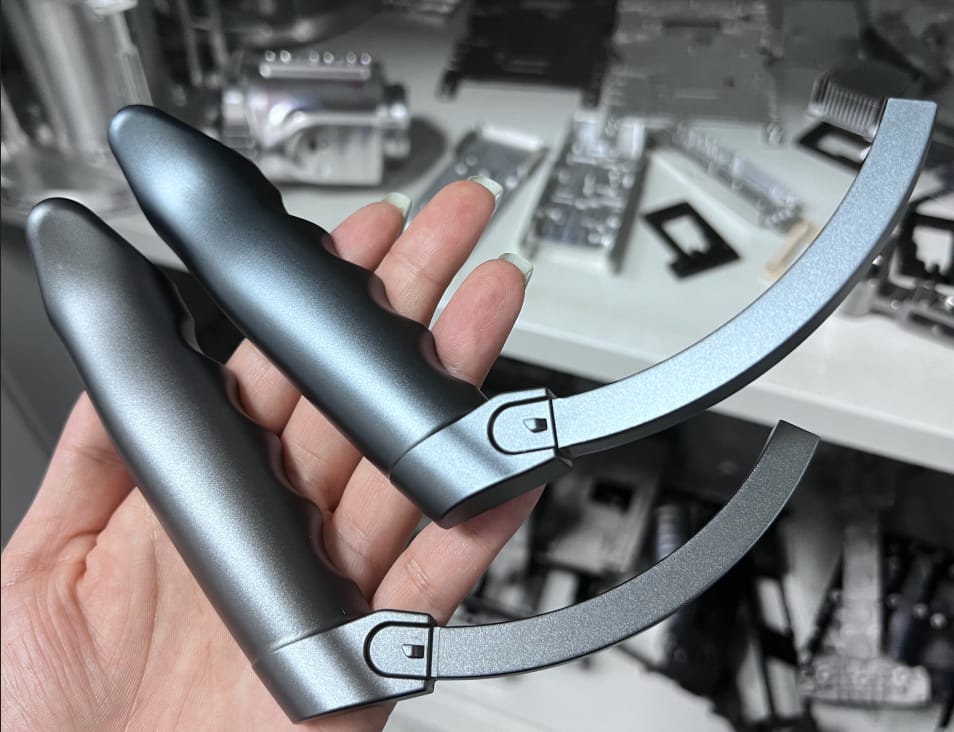
Aluminum provides nearly 3x the mass of standard thermoplastics. For the handheld levers shown in the image above, that added weight signifies durability and quality to the user. Furthermore, aluminum has high thermal conductivity. It feels cold to the touch. This “cold touch” is a subconscious indicator of premium build quality that 3D printed resin simply cannot simulate.
If your end product is metal, your validation prototype must be CNC Machining Services. Validating a metal design with a plastic print is like test-driving a sports car with a lawnmower engine—you aren’t getting the full experience.
Visual Analysis: Deconstructing the Finish
Let’s look closely at the image from our recent production run. These handles represent a classic challenge in CNC machining: organic surfacing combined with tight-tolerance assembly.
1. The Geometry and Surfacing
The handles feature complex, organic curves designed to fit the palm. In the CAD file, these are continuous splines.
- The Challenge: Reproducing these curves without visible “step-over” marks from the CNC cutter.
- The Solution: We utilized simultaneous 5-axis machining with fine-pitch ball nose end mills. This allows the tool to follow the contour of the part continuously, maintaining a constant chip load and surface speed.
2. The Surface Finish Strategy
The finish you see here is a Bead Blast (Glass Bead #120) followed by Type II Anodizing (Gunmetal Grey).
Why this specific combination?
- Grip: As mentioned in the social post, the bead blast creates a non-directional texture. It increases friction slightly—crucial for grip—without being abrasive.
- Aesthetics: The matte finish diffuses light, hiding fingerprints and reducing glare.
- Uniformity: Blasting unifies the surface, blending any microscopic tool marks left after the machining pass.
To learn more about how we achieve specific Ra (Roughness Average) values, explore our guide on Surface Finishing.
3. The Seamless Assembly
Notice the transition point where the handle connects to the pivot mechanism. The gap is virtually non-existent. Achieving this “seamless” look requires extremely tight tolerances, typically ISO 2768-m or tighter (±0.05mm).
If these parts were cast or 3D printed, you would likely see warping or layer lines at the mating interface. With CNC, we machine the mating surfaces flat and perpendicular to the pivot bore, ensuring that when the assembly clicks together, the transition line disappears.
Metal vs. 3D Printing for Functional Validation
I often get asked by procurement managers: “Jack, can’t we just SLA this for half the price?”
For visual models, yes. For functional validation, no.
Here is the breakdown of why Rapid Prototyping in metal is superior for this application:
| Feature | SLA/SLS (Plastic) | CNC Aluminum (6061-T6) |
|---|---|---|
| Isotropic Strength | Weak in Z-axis (layer adhesion) | Uniform strength in all directions |
| Threaded Holes | Requires inserts; threads strip easily | Can be tapped directly; holds high torque |
| Drop Testing | Likely to shatter or crack | Deforms plastically (realistic failure mode) |
| Snap-Fits/Hinges | Fatigues quickly | Durable for thousands of cycles |
If this handle is part of a medical device, it needs to survive drop tests and repeated sterilization cycles. CNC aluminum can withstand autoclaving; standard SLA resins cannot.
What Buyers Should Verify
Before placing an order, confirm material grade, tolerance-critical features, inspection methods, finishing limits, packaging, lead time, and applicable certifications with the selected manufacturing partner. SP Precision coordinates RFQ review, DFM communication, quotation, and supplier follow-up; project-specific production capabilities and certification documents are confirmed before order placement.
Conclusion
The “Hand-Check” never lies. When you place a prototype in a stakeholder’s hand, the tactile feedback—the weight, the texture, the temperature—does 80% of the selling.
Don’t compromise your design validation with lightweight plastics if your final product is meant to be robust. CNC aluminum prototypes bridge the gap between digital perfection and physical reality.
Are you ready to move your handheld device from CAD to a production-grade prototype?
For functional prototypes that need production-grade materials and fit checks, review our CNC prototype machining service.