In precision manufacturing, the machining process is only half the battle. You can hold a tolerance of +/- 0.005mm on a 5-axis mill, but if the surface aesthetics don’t align with the product’s market positioning, the part fails.
I often tell my clients in the US and Europe: The geometry defines the function, but the finish defines the value.
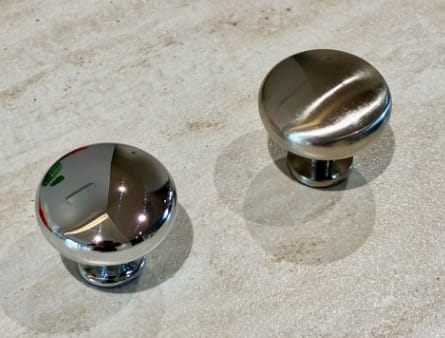
Looking at the image above, we see a perfect case study of this principle. These are two identical geometries—likely custom knobs for high-end audio equipment or industrial controls—yet they communicate entirely different engineering intents. One screams luxury; the other whispers durability.
In this post, I will break down the technical differences between Mirror Polishing and Brushed Finishing, analyze the machining challenges behind the photo, and help you decide which route is best for your next project.
Table of Contents
- Visual Analysis: The Tale of Two Knobs
- Technical Deep Dive: Mirror Polishing
- Technical Deep Dive: Brushed Satin
- The Engineering Trade-off: Cost vs. Function
Visual Analysis: The Tale of Two Knobs
Let’s look closely at the image provided. These parts appear to be turned on a CNC lathe and then post-processed.
- The Left Knob (Mirror Polish): This surface is highly reflective. You can clearly see the reflection of the ceiling lights and the surrounding environment on the convex surface. To achieve this, the Surface Roughness Average (Ra) has been brought down to approximately 0.02µm to 0.05µm. The challenge here is surface uniformity; any pit, scratch, or “orange peel” effect from the raw machining phase would be magnified by the gloss.
- The Right Knob (Brushed Satin): This part absorbs light rather than reflecting it. It features fine, directional striations (grain) that break up the surface visual. This looks to be a #4 architectural finish or a fine satin. The aesthetic is industrial and tactile, designed to be touched without fear of smudging.
Both parts likely started as the same raw stock—probably Stainless Steel 304 or 316, given the color tone, though Aluminum 6061 is also a candidate.
Technical Deep Dive: Mirror Polishing
Achieving the “Liquid Metal” look on the left isn’t just about buffing; it is about progressive material removal.
Mirror polishing is a labor-intensive process. After the CNC machining services are complete, we must sand the part through progressively finer grits—starting perhaps at 400 grit, moving to 800, 1500, and eventually 2000 or higher before using a buffing wheel with a polishing compound.
The Engineering Challenge:
- Tolerance Drift: Polishing removes material. If your part has a critical diameter tolerance (e.g., H7 fit), aggressive polishing can remove 0.01mm to 0.03mm, putting the part out of spec. We must program the CNC machine to leave “stock on” to account for this removal.
- Geometry Preservation: On a domed surface like this knob, manual polishing risks flattening the curvature if not done by a skilled technician.
Technical Deep Dive: Brushed Satin
The brushed finish on the right is achieved by abrading the surface with a grit belt or wire brush in a unidirectional pattern.
Unlike mirror polishing, which seeks to eliminate texture, brushing controls the texture. This is often the preferred choice for surface finishing on consumer electronics and kitchen appliances.
The Functional Advantage:
- Fingerprint Resistance: As noted in the social post, the brushed texture breaks up the oils from fingertips, keeping the part looking clean.
- Scratch Hiding: High-gloss surfaces show every micro-scratch. A brushed finish effectively hides wear and tear, making it ideal for high-touch user interfaces.
The Engineering Trade-off: Cost vs. Function
When you are moving from rapid prototyping to low-volume production, you need to weigh the cost implications of these finishes.
| Feature | Mirror Polish (High Gloss) | Brushed Satin (Matte) |
|---|---|---|
| Ra Value | < 0.05 µm | 0.8 µm – 1.6 µm |
| Labor Cost | High (Requires multiple stages) | Medium (Faster process) |
| Durability | Low (Scratches easily visible) | High (Hides wear) |
| Best Application | Decorative trim, medical instruments | Handles, casings, industrial panels |
Jack’s Pro-Tip: If you require a mirror finish, ensure your base material is high quality. We recommend Vacuum Arc Remelted (VAR) stainless steel for the absolute best results, as it minimizes impurities that can appear as “comet tails” during polishing.
What Buyers Should Verify
Before placing an order, confirm material grade, tolerance-critical features, inspection methods, finishing limits, packaging, lead time, and applicable certifications with the selected manufacturing partner. SP Precision coordinates RFQ review, DFM communication, quotation, and supplier follow-up; project-specific production capabilities and certification documents are confirmed before order placement.
Conclusion
The choice between mirror and brushed finishing is rarely just about “what looks cool.” It is a decision that impacts unit cost, lead time, and the longevity of the product in the field.
If you have a design ready and need an expert opinion on the best finishing strategy, let’s talk.