In the world of manufacturing, a “bad part” usually means a production delay or a financial write-off. In the medical sector, a bad part impacts a human life.
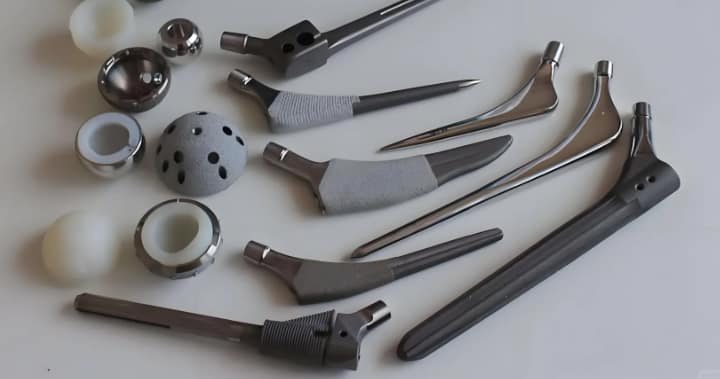
There is a unique weight on our shoulders when we machine components destined for the operating room. The image above—a collection of hip stems, acetabular cups, and liners—represents the absolute pinnacle of medical CNC machining. These aren’t just shaped metal; they are biomechanical solutions that must survive the hostile environment of the human body for decades.
For procurement managers and engineers sourcing these components, understanding the “how” is just as important as the “what.” At Rapid Model, we don’t just cut metal; we engineer reliability. Here is a technical deep dive into the manufacturing challenges of the orthopedic components shown in this collection.
Table of Contents
- The Material Paradox: Titanium & Cobalt-Chrome
- Visual Analysis: Deconstructing the Hip System
- Surface Engineering: Roughness vs. Polish
- Tolerances: The Reality of the Morse Taper
- Why Rapid Model for Medical Prototyping?
1. The Material Paradox: Titanium & Cobalt-Chrome
The primary challenge in orthopedic manufacturing is that the best materials for the body are often the worst materials for a CNC machine.
Looking at the grey, metallic femoral stems in the photo, we are likely looking at Titanium Ti-6Al-4V (Grade 5) or Cobalt-Chrome-Molybdenum (CoCrMo).
The Titanium Challenge
Titanium is biocompatible and has a modulus of elasticity closer to bone than steel, reducing stress shielding. However, from a machining perspective, it is a heat sink nightmare. Titanium has poor thermal conductivity. Unlike steel, where heat dissipates into the chip, titanium retains heat at the cutting edge.
This leads to:
- Work Hardening: If the cutter dwells or feeds too slowly, the material hardens instantly, destroying the tool.
- Built-Up Edge (BUE): Material welding to the cutter.
To combat this, our CNC machining services utilize high-pressure coolant systems and specialized carbide tooling with sharp positive rake angles to shear the metal cleanly rather than plowing through it.
2. Visual Analysis: Deconstructing the Hip System
Let’s analyze the specific components visible in the image provided. This is a Total Hip Arthroplasty (THA) system, and each segment requires a different manufacturing approach.
The Femoral Stems (The Long Metal Parts)
These stems are inserted into the femur. You will notice complex, organic curves. These cannot be machined efficiently on a 3-axis mill. They require 5-axis simultaneous milling to follow the anatomical contour without re-fixturing. This ensures the grain structure of the metal remains consistent and tolerances are held tight across the entire sweep of the part.
The Acetabular Cups (The Hemispheres)
These cups sit in the hip socket. The manufacturing challenge here is wall thickness consistency. Machining a thin-walled titanium hemisphere requires careful workholding strategy to avoid deformation. If you clamp it too hard, it springs back out of round when released. If you clamp it too loosely, the part chatters.
The Liners (The White Components)
The white cups shown are likely Ultra-High Molecular Weight Polyethylene (UHMWPE). While softer than metal, machining plastic for medical use is deceptive. UHMWPE is prone to warping due to thermal expansion and can develop “fuzzy” surfaces if the tool isn’t razor-sharp. We use dedicated tooling for plastics to prevent cross-contamination from metal particles.
3. Surface Engineering: Roughness vs. Polish
In medical device manufacturing, surface finish is functional, not just aesthetic. The image clearly displays two opposing surface technologies.
Osseointegration (The Rough)
Look closely at the outer shells of the acetabular cups and the proximal (top) section of the hip stems. They appear matte, textured, or even “sandy.”
This is intentional. This porous coating (often achieved through plasma spraying or sintering titanium beads) mimics the structure of cancellous bone. It invites osseointegration, where the patient’s bone literally grows into the metal, locking the implant in place without cement.
Articulation (The Smooth)
Conversely, the trunnion (the neck where the ball head sits) and the inner surfaces must be mirror-smooth. Any micro-scratch here acts as an abrasive against the polyethylene liner, creating wear debris that leads to osteolysis (bone loss).
Achieving these contrasting finishes on a single part requires a mastery of surface finishing techniques, ranging from bead blasting to electropolishing and precision grinding to achieve Ra values lower than 0.05µm.
4. Tolerances: The Reality of the Morse Taper
One feature not immediately obvious to the naked eye, but critical to the machinist, is the Morse Taper.
At the top of the femoral stem, there is a tapered cone where the ball head attaches. This is a “cold weld” friction fit. The angle tolerance here is measured in seconds of a degree. If the taper angle is off by even a fraction, the head will not seat correctly, leading to fretting corrosion and eventual implant failure.
This level of precision requires:
- Rigid CNC setups.
- In-process probing.
- Validation via CMM (Coordinate Measuring Machines) in a temperature-controlled environment.
5. Why Rapid Model for Medical Prototyping?
Before these implants reach mass production (casting or forging), they start as prototypes. Medical device R&D requires iterative testing to validate geometry and fit.
At Rapid Model, we specialize in bridging the gap between design and production.
- Speed: We understand that FDA/CE approval clocks are ticking. Our rapid prototyping services can deliver functional titanium or CoCr prototypes in as little as 3 days.
- Material Certification: We provide full traceability (DFM, Material Certs, Inspection Reports) for every medical grade alloy we machine.
- Scalability: We can handle the single prototype for a cadaver lab and the low-volume pilot run for clinical trials.
Conclusion
Manufacturing for the medical sector is the hardest sector to master because “good enough” does not exist. It combines exotic, difficult-to-machine alloys with complex geometries and conflicting surface finish requirements.
Whether you are designing the next generation of orthopedic stems or surgical instrumentation, you need a manufacturing partner who understands the biology behind the metal.
Are you ready to validate your medical device designs?