In the world of fluid power, a component’s reliability is often determined by what you cannot see. To the untrained eye, a hydraulic manifold block looks like a simple chunk of metal with a few holes drilled into it. To a mechanical engineer or a procurement manager sourcing critical components, however, it is a complex logic system where a single microscopic flaw can lead to catastrophic system failure.
At Rapid Model, we often say that “it is what is inside that counts.” Today, I want to break down the engineering reality behind CNC machined hydraulic manifolds, analyzing a specific part from our production line to highlight the machining challenges, surface finishing requirements, and the critical importance of internal cleanliness.
Visual Analysis: More Than Just a Metal Block
Let’s look closely at the image of the manifold block recently machined here in our Shenzhen facility.
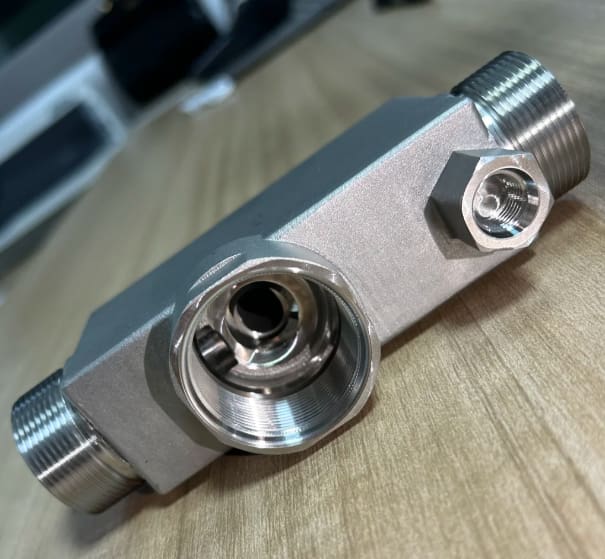
From a manufacturing standpoint, this part tells a specific story about precision and material science.
1. Material and Finish
The visual texture indicates this is likely Aluminum 6061-T6. The matte, uniform grey appearance is the result of a fine bead blast. While this looks aesthetically pleasing, the engineering function is paramount. In surface finishing, bead blasting is crucial for removing machining marks and creating a uniform surface profile (Ra). This increases the surface area, which provides superior adhesion for subsequent anodizing or chemical conversion coatings. Without this prep, corrosion resistance in harsh hydraulic environments would be compromised.
2. Complex Geometry (Mill-Turn Requirements)
Notice the ends of the block. These aren’t standard flat faces; they feature integrated male threads. This suggests the part likely required a setup on a 5-axis machine or a multi-tasking mill-turn center. Achieving perfect concentricity between the central axis of the block and those threaded ends is vital. If the thread is slightly off-axis, the fitting will bind, leading to leaks under high pressure.
3. The Critical “Spot Face”
Look at the two ports on the top face. You will see a distinct, machined flat area surrounding the threaded hole—this is the spot face. In hydraulic assemblies, the seal (usually an O-ring or bonded washer) relies entirely on this surface.
- Flatness: It must be perfectly flat.
- Perpendicularity: It must be perfectly perpendicular to the thread axis.
- Finish: The surface roughness here must be smoother than the rest of the block to ensure a hermetic seal.
The Hidden Challenge: Internal Cross-Drills
The external features are challenging, but the real “magic”—and the highest risk—happens inside. A manifold is essentially a switchboard for fluid. Channels drilled from the X, Y, and Z axes must intersect at precise coordinates to route fluid flow.
When a drill bit breaks through into an existing cross-channel, it creates a burr at the intersection point. In a CNC machining service, managing these “blind” burrs is one of the most difficult tasks we face.
Why Internal Burrs are Fatal
If a burr is left inside a manifold:
- Flow Restriction: Large burrs can impede fluid dynamics, causing pressure drops or turbulence.
- Component Destruction: The scariest scenario is the “break-off.” Under high hydraulic pressure (often 3000+ PSI), a metal burr can detach. It then travels downstream until it hits a solenoid valve or a hydraulic pump. A single aluminum chip can seize a pump or score a cylinder wall, causing thousands of dollars in damage to the final machinery.
Verification: How We Ensure Cleanliness
At Rapid Model, we don’t guess; we verify. Standard visual inspection isn’t enough for complex fluid power components. We utilize a combination of methods to ensure the part is free of debris.
1. Thermal Deburring (TEM)
For high-volume production, we utilize Thermal Energy Method (TEM). This process places the manifold in a pressurized chamber with a gas mixture. When ignited, the gas releases a burst of heat that instantly vaporizes thin burrs without altering the dimensions of the solid block.
2. Electrochemical Deburring (ECD)
For delicate features where heat might affect temper, ECD dissolves burrs using a salt solution and electricity, focusing only on the sharp edges.
3. Borescope Inspection
For lower volume or high-precision prototypes (typical in rapid prototyping), we use industrial borescopes. These fiber-optic cameras allow our QC engineers to visually inspect the intersection of cross-drills deep inside the block.
Design for Manufacturing (DFM) Tips for Manifolds
If you are a product designer working on hydraulic components, here are three tips to lower your costs and improve quality:
- Standardize Port Sizes: Stick to standard SAE, BSPP, or NPT sizes to allow the use of standard tooling. Custom thread forms require custom taps, increasing lead time.
- Allow for Drill Drift: Deep drilling (anything over 10x diameter) will result in drill wander. Design your internal channels with enough clearance so that slight wander doesn’t breach a wall.
- Specify Deburring Requirements: Clearly state “Free of Burrs and Chips” on your drawing, but also specify critical areas where no edge breaking is allowed (like sealing lands).
The Rapid Model Advantage
Sourcing hydraulic manifolds from China requires trust. You need a partner who understands that a manifold isn’t just a block—it’s the heart of your machine.
At Rapid Model, we combine ISO 9001-certified quality management with advanced 5-axis CNC capabilities. Whether you need a single prototype to test a new fluid circuit or a production run of 5,000 anodized blocks, we have the capacity and the technical know-how to deliver.
We understand the stakes. We know that a leak means downtime, and downtime means lost revenue for your customers. That is why we treat every spot face and every internal cross-drill with the precision it demands.
Ready to Optimize Your Hydraulic Components?
Don’t let internal burrs or poor surface finishes compromise your fluid power systems. Let’s discuss your current project requirements. Send us your CAD files today for a comprehensive DFM review and a competitive quote.