In high-performance engineering, every gram counts. Whether you are shaving seconds off a lap time in Formula 1 or maximizing payload capacity in an aerospace launch vehicle, the fasteners holding your assembly together are critical. They are often the unsung heroes of mechanical design.
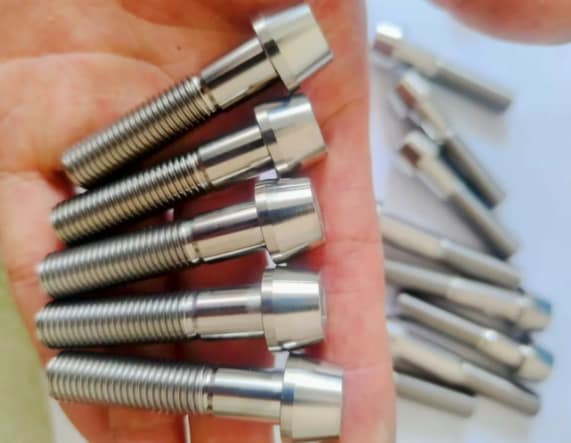
At Rapid Model, we frequently handle orders for custom fasteners that standard catalogs simply cannot fulfill. The image above shows a batch of custom-turned titanium bolts we recently completed. To the untrained eye, they look like standard hardware. To a mechanical engineer, they represent a specific balance of tensile strength, fatigue resistance, and weight reduction.
Today, I want to break down the specific engineering choices visible in these parts, the challenges of CNC machining services when working with Titanium Grade 5, and why this material remains the gold standard for lightweight performance.
Visual Analysis: Deconstructing the Part
Let’s look closely at the fasteners in the photo. These are not your standard DIN or ISO off-the-shelf bolts. Several features indicate these were custom-engineered for a specific load case:
- The Tapered Head: Unlike a standard cylindrical socket cap, these heads feature a conical taper. In automotive applications, this is often done to seat into a countersunk hole for aerodynamic flushness, or simply to shave off “dead weight” from the head volume where material stress is lower.
- The Grip Length (Shank): You will notice a smooth, unthreaded section under the head. This is the “grip.” In high-shear applications, you never want the threads to sit inside the shear plane (the joint interface). The smooth shank provides maximum cross-sectional area and bearing strength.
- Distinct Grey Hue: That specific metallic grey matte finish is the hallmark of machined Titanium. It lacks the shine of stainless steel or the darkness of carbon steel, signaling immediate corrosion resistance without the need for zinc or nickel plating.
Why Titanium Grade 5 (Ti-6Al-4V)?
We machine a lot of metals at Rapid Model, but Titanium Grade 5 (Ti-6Al-4V) is the dominant alloy for a reason. It accounts for over 50% of global titanium usage.
For a Procurement Manager or Engineer deciding on materials, here is the data that matters:
- Strength-to-Weight Ratio: Titanium Gr5 is roughly 60% denser than aluminum but twice as strong. More importantly, it is 45% lighter than steel while offering comparable—and often superior—tensile strength (approx. 1000 MPa).
- Corrosion Resistance: Unlike steel, which requires plating (which changes dimensions) or painting, titanium naturally forms a stable, continuous, and tightly adherent oxide film. It is immune to atmospheric corrosion, making it ideal for exposed automotive suspension parts or aircraft skins.
- Temperature Stability: While aluminum softens significantly above 150°C, Grade 5 Titanium maintains its mechanical properties up to 400°C (752°F).
The Manufacturing Challenge: Machining Titanium
“It challenges our CNC machines.” I wrote that in my social post, and I meant it.
Titanium is classified as a “difficult-to-cut” material. It has low thermal conductivity. When we machine steel, the heat generated usually dissipates into the chip, which flies away from the part. With titanium, the heat tends to concentrate in the cutting tool and the workpiece itself.
To produce the bolts shown above without compromising their temper or dimensions, we utilize specific strategies:
1. High-Pressure Coolant & Rigid Setup
We must prevent heat buildup. If the heat gets too high, titanium can chemically react with the cutting tool material, leading to rapid tool failure and poor surface finish. We use high-pressure coolant systems to blast chips away and keep the interface cool.
2. Preventing Galling
Titanium has a tendency to “gall” or weld itself to the cutting tool. We use sharp, positive-rake tooling with specialized coatings (like TiAlN) to ensure a clean shear rather than a smear.
3. Rolled Threads vs. Cut Threads
If you look at the threads in the image, they are incredibly precise. For high-stress fasteners, we often recommend thread rolling over thread cutting.
- Cut Threads: The grain structure of the metal is severed.
- Rolled Threads: The material is cold-formed. The grain flows with the contour of the thread.
- The Result: Rolled threads have significantly higher fatigue resistance—crucial for parts subjected to the vibration of a race car engine or turbine.
From Prototype to Production
Often, our clients start with rapid prototyping to test the fit and assembly of these custom fasteners. We might machine a small batch of 10 or 20 units (like the handful shown in the photo) to verify the thread pitch and head clearance.
Once the design is validated, we move to Swiss-style CNC turning centers for production. These machines can turn, mill the hex socket, and thread the part in a single operation, ensuring high concentricity and lower unit costs.
Surface Finishing Considerations
While the parts in the image appear “as-machined,” surface treatment is still a factor. Titanium looks great raw, but for specific applications, we offer various surface finishing options:
- Bead Blasting: To create a uniform matte texture and hide tool marks.
- Anodizing: Unlike aluminum anodizing, titanium anodizing is biocompatible and can produce a spectrum of colors (Gold, Blue, Purple) without dyes, purely by adjusting the oxide layer thickness. This is popular in motorsport for color-coding parts.
- PVD Coating: For extreme wear resistance.
The Rapid Model Advantage
At Rapid Model in Shenzhen, we understand that a bolt isn’t just a bolt—it’s a critical component of a larger system. Whether you are an engineer in Germany designing a suspension system or a product designer in the USA working on aerospace drones, you need parts that meet spec, every time.
We combine 3-axis, 4-axis, and 5-axis CNC capabilities with ISO 9001 quality control processes. We don’t just cut metal; we review your GD&T, suggest Design for Manufacturing (DFM) improvements, and deliver parts that fit perfectly right out of the box.
Do you have a complex geometry or a high-performance material requirement? Let’s discuss how we can manufacture it.