In the world of product development, mechanical engineers and procurement managers often spend 90% of their energy focusing on geometric tolerances, material properties, and structural integrity. This is necessary, but it overlooks a critical reality: the end-user judges the product by its surface.
You can have a CNC machined part with ±0.005mm tolerance, but if the surface finish is inconsistent or the paint peels, the product is perceived as “low quality.”
At Rapid Model, we often say that manufacturing is engineering, but surface finishing is pure art grounded in science. Today, I want to break down a specific, high-difficulty finishing process we recently completed: a high-gloss, metallic gradient spray application.
Visual Analysis: The “Purple-to-Blue” Challenge
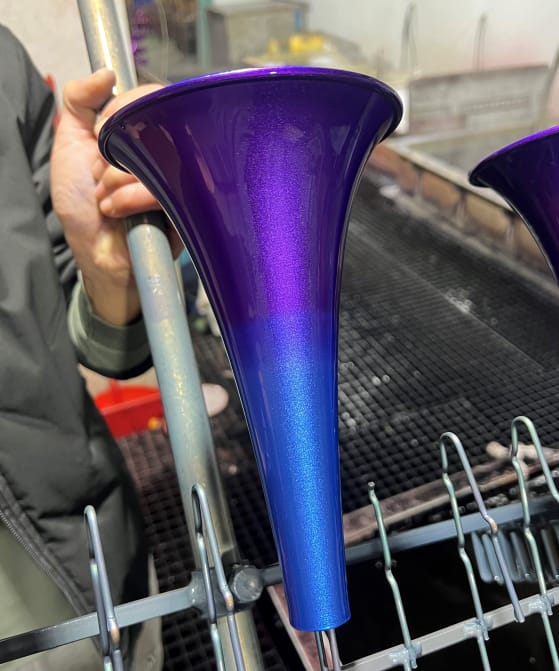
Take a close look at the image above from our finishing department. These parts—likely velocity stacks or audio horn components—present a unique set of challenges due to their geometry and the aesthetic requirements.
1. The Geometry
The part features a funnel shape with a deep internal curvature. In custom spray painting services, this is known as a Faraday cage area (though that term is more specific to powder coating, the aerodynamic principle applies to wet spray). It is difficult to get paint deep into the throat of the funnel without causing “runs” or “sags” on the outer rim due to excessive build-up.
2. The Gradient Transition
The client required a seamless fade from a deep, royal purple into a metallic cyan-blue.
- The Problem: In a standard paint job, you spray one color. In a gradient, you are blending two wet materials on the surface. If the atomization pressure is too high, the colors muddy together. If it’s too low, you get a “speckled” transition where the dots of paint are visible to the naked eye.
- The Solution: This requires a wet-on-wet application technique where the painter must control the gun distance and overlap percentage manually. This is not something a standard robotic arm can easily replicate without complex programming for low-volume runs.
3. The Metallic Flake (The “Flop”)
As mentioned in our recent social update, you can see the metallic flake “popping” under the inspection light. In automotive terms, we look for the “flop”—how the metallic particles orient themselves.
- Good Flop: Flakes lay flat, reflecting light uniformly.
- Bad Flop: Flakes stand vertically, making the paint look cloudy or dark from side angles.
Achieving a consistent flop on a curved surface requires the painter to maintain a perpendicular angle to the surface tangent at all times.
The Process: From Raw CNC to Showroom Shine
How do we achieve this level of finish? It starts long before the spray gun is loaded.
Step 1: Substrate Preparation
Whether we are working with ABS plastic from a 3D printer or Aluminum 6061 from our CNC machining services, the surface must be flawless. High-gloss paint acts like a magnifying glass for surface defects. A microscopic scratch on the raw part will look like a trench once glossy clear coat is applied.
- Sanding: We step-sand from 400 grit up to 1500 grit.
- Priming: We use a high-build primer to fill micro-pores, followed by another round of sanding.
Step 2: The Base Coat Application
For the part shown, we apply a black base coat first. Metallic colors often require a dark backing to achieve depth. Without this, the purple would look translucent and “thin.”
Step 3: The Gradient Application
This is where the skill of our senior technicians comes into play.
- Zone 1: The purple is sprayed on the upper section.
- Zone 2: The blue is sprayed on the lower section.
- The Blend Zone: The technician feathers the trigger, reducing fluid flow while maintaining air pressure, to mist the blue over the edge of the purple. This creates the optical illusion of a fade.
Step 4: Clear Coat and Polishing
To protect the metallic flakes and provide UV resistance, we apply a 2K (two-component) high-gloss clear coat. Once cured, we inspect for “orange peel” (surface texture). If necessary, we wet-sand the clear coat and buff it to a mirror finish.
Why Use Spray Painting for Rapid Prototyping?
I often get asked by clients in the USA and Europe: “Jack, why not just mold it in color?”
For mass production (100,000+ units), injection molding in specific colors is cost-effective. However, for rapid prototyping or low-volume production (1 to 500 units), custom spray painting offers specific advantages:
- Unlimited Color Matching: We can match any Pantone (PMS) or RAL color, or even custom automotive swatches (like the Maziora style color-shift shown in the image).
- Hiding Substrate Variations: If you have a prototype assembly made of mixed materials (e.g., an SLA printed section glued to a CNC machined aluminum base), painting unifies the look. The viewer sees one cohesive product, not a patchwork of materials.
- Texture Control: We can manipulate the paint to be high-gloss, satin, matte, or even soft-touch (rubberized feel) without changing the underlying tool or mold texturing.
Quality Control: How We Inspect Cosmetic Parts
At Rapid Model, we don’t just “look” at the part. We use data-driven inspection standards.
- Visual Inspection Distance: Parts are inspected at a distance of 30-50cm under D65 standard daylight lighting.
- Adhesion Testing: We perform ASTM D3359 cross-hatch tape testing on sample coupons to ensure the paint won’t flake off during assembly or shipping.
- Gloss Measurement: Using a gloss meter, we ensure the reflectivity hits the target GU (Gloss Units). For a finish like the one in the image, we aim for >90 GU.
The Rapid Model Advantage
Many CNC shops outsource their finishing. This creates a “blame loop.” If the paint fails, the painter blames the machinist for using the wrong cutting fluid, and the machinist blames the painter for poor prep.
At Rapid Model, we handle the entire workflow. From the 5-axis CNC milling to the final clear coat application, we control the quality chain. This ensures that when you receive your prototypes in California or Berlin, they look exactly like the render your design team approved.
Are you struggling with a complex cosmetic finish? Do you need a partner who understands that “metallic blue” isn’t just a color, but a technical specification?
Let’s discuss your next project.