When mechanical engineers and product designers evaluate materials for high-wear, high-friction environments, brass is rarely chosen just for its aesthetic warmth. While a freshly machined brass component possesses an undeniable visual appeal, its true value lies in its mechanical properties. At Rapid Model, we frequently work with procurement teams across the USA and Europe who require reliable, tight-tolerance parts for critical assemblies.
In this post, we will break down the technical realities of manufacturing precision brass wear rings and bushings, analyzing the specific features of these components and the machining strategies required to produce them flawlessly.
Table of Contents
- Material Analysis: Deconstructing the Brass Wear Ring
- The Technical Deep Dive: Why Brass?
- Machining Challenges and Solutions
- The Rapid Model Advantage
- Conclusion
- Material Analysis: Deconstructing the Brass Wear Ring
- The Technical Deep Dive: Why Brass?
- Machining Challenges and Solutions
- The Rapid Model Advantage
- Conclusion
Material Analysis: Deconstructing the Brass Wear Ring
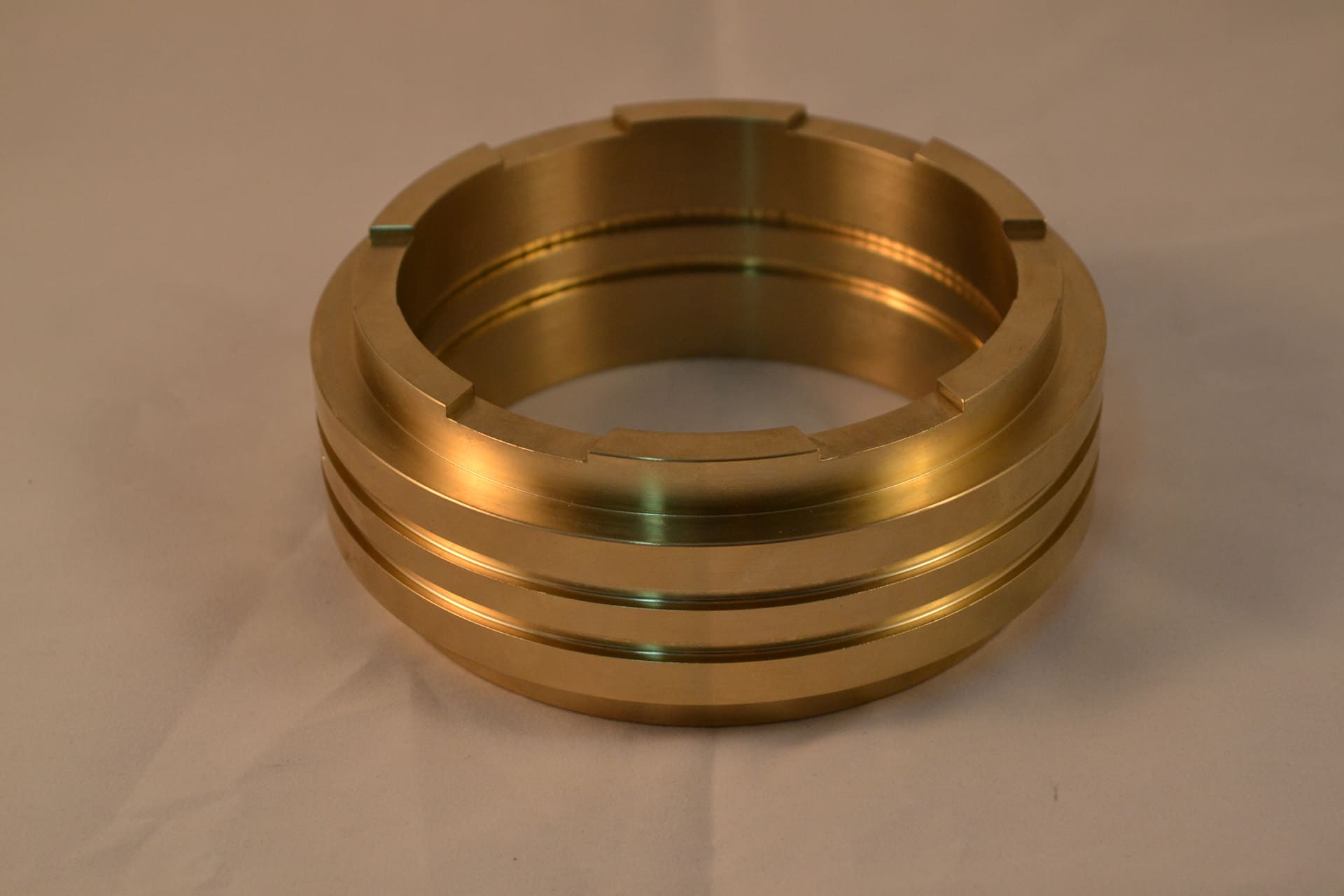
Take a close look at the brass component featured above. To the untrained eye, it is simply a metal ring. To a CNC machinist or mechanical engineer, it is a complex geometry designed for a highly specific function—likely operating as a locking bushing, a dynamic seal retainer, or a heavy-duty wear ring in a fluid power system.
Here is a technical breakdown of its visible features:
- External Circumferential Grooves: The outer diameter (OD) features deep, precisely machined grooves. These are almost certainly O-ring glands designed for dynamic or static sealing. The surface finish within the root of these grooves must be exceptionally smooth to prevent O-ring abrasion during thermal expansion or mechanical vibration.
- Top Face Castellations (Notches): The top edge features evenly spaced, milled notches. These are typically designed for a spanner wrench, allowing a technician to apply high torque to lock the component into a threaded assembly. Alternatively, these notches serve as indexing points for alignment within a larger mechanical housing.
- Stepped Inner Diameter (ID): While partially obscured by the angle, the internal bore shows signs of a stepped profile or internal grooving. This suggests the part houses a secondary component, such as a shaft or a bearing, requiring strict concentricity between the ID and the OD.
Producing a part with this combination of turned and milled features requires advanced CNC machining services to ensure that all geometric dimensions and tolerances (GD&T) are strictly met.
The Technical Deep Dive: Why Brass?
Why specify brass for a component like this instead of stainless steel or aluminum? The decision usually comes down to three critical engineering factors:
- Inherent Lubricity: Brass alloys, particularly those containing trace amounts of lead (like C36000 Free-Machining Brass), offer excellent natural lubricity. When this component rubs against a steel shaft or housing, the brass will not gall or seize. It acts as a sacrificial wear part, protecting the more expensive steel components in the assembly.
- Corrosion Resistance: In applications involving water, pneumatics, or certain industrial chemicals, brass forms a protective patina that prevents deep, structural rusting. This makes it a staple in marine engineering, plumbing fixtures, and hydraulic valves.
- Machinability: Free-machining brass is the industry standard by which all other metals are judged for machinability (rated at 100%). This allows us to run our CNC lathes and mills at exceptionally high speeds and feeds, reducing cycle times and lowering the overall cost per part for our clients.
Machining Challenges and Solutions
Despite its excellent machinability rating, CNC machining brass components of this complexity is not without its challenges.
Concentricity and Runout
For a wear ring or sealing gland, the runout between the inner bore and the outer O-ring grooves must often be held to within 0.01mm to 0.02mm. If the part is removed from a lathe and moved to a mill to cut the top notches, you risk losing that concentricity. To mitigate this, we utilize advanced mill-turn centers. By turning the OD, boring the ID, and milling the top castellations all in a single setup, we eliminate fixture-induced tolerance stack-up.
Burr Control
Brass is notorious for forming micro-burrs when milled, especially around sharp corners like the top notches shown in the image. If left unchecked, a burr could break off during operation and contaminate a hydraulic line. We implement strict toolpath strategies, using sharp carbide end mills and programmed chamfering passes to deburr the part directly inside the machine.
Surface Quality
O-ring grooves require a specific Ra (Roughness Average) to seal properly. While brass cuts cleanly, achieving a mirror-like finish requires precise control of spindle speed and feed rate during the finishing pass. Depending on the application’s demands, we may also utilize secondary surface finishing techniques to enhance the part’s wear characteristics or aesthetic appeal.
The Rapid Model Advantage
At Rapid Model, operating out of Shenzhen, China, we bridge the gap between high-quality engineering and cost-effective manufacturing. We understand that procurement managers in the USA and Europe cannot afford supply chain delays or out-of-spec parts.
Whether you are in the early stages of product development and require rapid prototyping to test a new valve design, or you need a production run of 10,000 precision brass wear rings, our ISO 9001-certified facility is equipped to handle it. Our 5-axis CNC capabilities and rigorous CMM (Coordinate Measuring Machine) inspections ensure that every custom CNC machined part exactly matches your CAD data.
Conclusion
A perfectly machined brass component is a testament to the harmony between material science and manufacturing precision. From its natural lubricity to the exactness of its O-ring grooves and locking notches, every detail serves a distinct engineering purpose.
If your next project requires high-quality brass components, bushings, or wear rings, partner with a factory that understands the technical “why” behind your designs.
Ready to optimize your supply chain with precision CNC machined parts?