In the world of fluid power and subsea engineering, a component failure isn’t just an inconvenience—it’s a catastrophe. Whether you are designing for offshore oil rigs or heavy industrial hydraulics, the integrity of your connection points is non-negotiable.
At Rapid Model, we often receive inquiries for “standard fittings,” but as any experienced mechanical engineer knows, there is nothing standard about managing pressures exceeding 5,000 PSI or surviving saltwater corrosion for two decades.
Today, I want to walk you through a recent batch of heavy-duty stainless steel fittings we produced. We will analyze the specific machining challenges presented by this design and discuss why precision manufacturing is the only safety factor that truly matters.
Table of Contents
- Visual Analysis: Built for Hoop Stress
- The Material Challenge: Machining Stainless Steel
- Critical Features: Threads, Bores, and Finishes
- From Prototype to Production
- The Rapid Model Advantage
Visual Analysis: Built for Hoop Stress
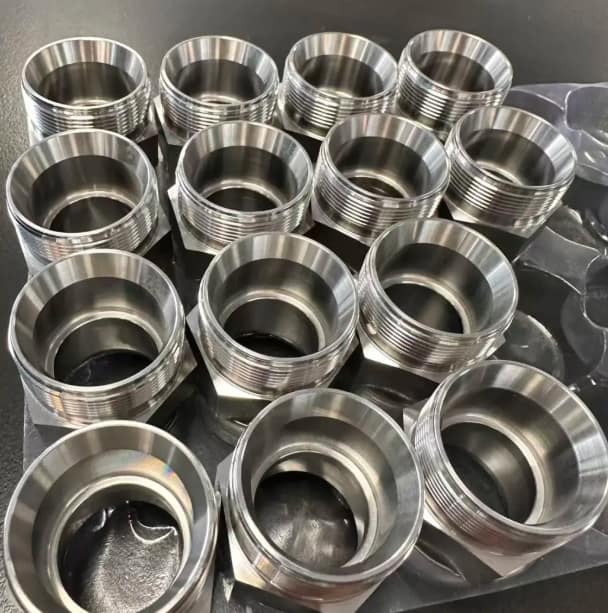
Take a close look at the image above. These aren’t your average hardware store plumbing parts. As a manufacturing specialist, several features immediately stand out to me regarding the design intent and the machining strategy required.
The most obvious feature is the wall thickness. In hydraulic applications, hoop stress (the force exerted circumferentially perpendicular to the axis and the radius of the cylinder wall) is the primary enemy. The designers here prioritized a massive safety factor.
From a manufacturing standpoint, this part features a hexagonal base transitioning into a cylindrical threaded section. This geometry suggests the raw material was likely high-grade hexagonal bar stock, processed on a CNC turning center. The substantial mass of the part aids in vibration dampening during the cutting process, but it also requires rigid workholding to prevent chatter when turning those critical external threads.
The Material Challenge: Machining Stainless Steel
Based on the application profile—high-pressure hydraulics or subsea environments—these parts are almost certainly machined from Stainless Steel 316 or 316L. While 304 is common, 316 offers the molybdenum content necessary to resist pitting in chloride environments (like seawater).
However, stainless steel is notorious for work hardening. If your CNC machining services provider uses incorrect feed rates or dull tooling, the material hardens instantly at the cutting interface. This leads to:
- Premature tool failure.
- Poor dimensional tolerances.
- Induced internal stresses in the part.
At Rapid Model, we mitigate this by maintaining constant feed rates and utilizing high-performance carbide tooling with specific coatings (like TiAlN) designed to manage the heat generation inherent in cutting nickel-chromium alloys.
Critical Features: Threads, Bores, and Finishes
The “devil is in the details,” as the saying goes. In high-stakes manufacturing, the details are defined by GD&T (Geometric Dimensioning and Tolerancing). Let’s break down the three critical areas of these fittings.
1. The Internal Surface Finish
Looking down the bore of these fittings, you will notice a distinct lack of tool marks. In hydraulic systems, fluid turbulence causes heat and efficiency loss. A rough internal bore can also become a nucleation site for corrosion or fatigue cracks.
We target a specific Ra (Roughness Average) value—typically Ra 0.8µm or better for these applications. Achieving this requires a final finishing pass with a specialized boring bar or a honing process. For applications requiring mirror-like smoothness, we can also apply advanced surface finishing techniques such as electropolishing, which not only smooths the surface but enhances the passive oxide layer of the stainless steel.
2. External Threads and Galling Prevention
The external threads shown in the image are cut cleanly with no burrs. In stainless steel applications, galling (cold welding) is a significant risk during assembly. If the thread quality is poor or the pitch diameter is slightly off, the friction during tightening will cause the male and female threads to seize together permanently.
We prevent this through:
- Single-point threading: Using CNC turning for precise thread profiles rather than using a die.
- Thread Gaging: Every batch is checked with Go/No-Go gauges to ensure compliance with UN or Metric standards.
3. Chamfers and Handling
You will notice generous chamfers on the hex edges and the thread lead-in. While this aids in assembly, it is also a safety feature for the assembly technicians. Burrs on stainless steel are razor-sharp. A proper chamfer ensures the part can be handled safely despite its heavy weight.
From Prototype to Production
When developing components for high-pressure systems, you rarely go straight to mass production. You need to validate the design first.
Perhaps you need to test different wall thicknesses to balance weight vs. burst pressure, or maybe you need to test 316L versus 17-4 PH stainless steel. This is where rapid prototyping becomes essential.
At Rapid Model, we can machine a single unit or a small batch of 10 parts using the exact same materials and processes as the final production run. This allows your engineering team to perform destructive testing (burst tests) on a representative part, ensuring the design holds up before you commit to thousands of units.
The Rapid Model Advantage
Why do procurement managers in the USA and Europe trust a Shenzhen factory with their critical components? It comes down to the intersection of speed, quality, and technical competence.
We operate ISO 9001-certified facilities equipped with 3-axis, 4-axis, and 5-axis CNC machines. But machines are only as good as the operators. My team understands that a drawing isn’t just lines on a PDF; it’s a set of functional requirements.
When we see a heavy-duty fitting like the one in the image, we don’t just quote a price. We review the print for manufacturability. We ask about the concentricity requirements between the thread and the bore. We confirm the material certification. We act as an extension of your engineering team.
Ready to secure your supply chain?
If you have a design that requires heavy-duty turning, tight tolerances, and materials that are tough to machine, let’s talk. Whether it’s for hydraulic, aerospace, or industrial applications, we have the capacity to handle the pressure.