Source custom CNC turned and turn-mill parts with drawing review, concentricity planning, inspection coordination, finishing, and repeat-order follow-up.
SP Precision coordinates RFQ review and production through qualified manufacturing partners in China. Machine capability, material, tolerances, reports, secondary operations, and delivery timing are confirmed against each project.
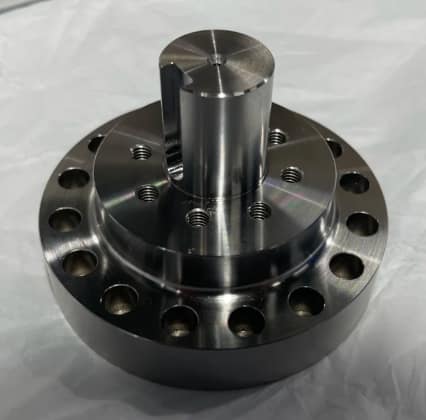
When CNC Turning Is the Right Process
CNC turning is commonly used for shafts, pins, bushings, sleeves, spacers, flanges, fittings, couplings, rollers, threaded components, and valve parts. The process is especially relevant when functional features are arranged around a rotational centerline and when outside diameters, bores, shoulders, grooves, tapers, or threads must relate to one another.
Part diameter, length-to-diameter ratio, stock form, material, feature access, workholding, runout requirements, secondary operations, and batch quantity all influence the route. We review the complete RFQ before selecting a manufacturing partner rather than assuming that every turned part belongs on the same type of machine.
CNC Turning, Live Tooling, and Turn-Mill Machining
Conventional turning is effective for rotational geometry. Live tooling or turn-mill machining may be considered when a turned part also needs cross holes, flats, slots, keyways, off-axis holes, or milled faces. Completing features in one production route can reduce handling and datum transfers, but it must be compared with a separate milling operation on cost, access, setup risk, and inspection.
The final route depends on the geometry and order requirements. For broader process selection, review our CNC machining and prototyping services.
Concentricity, Runout, and Datum Planning
Terms such as concentricity, coaxiality, circular runout, and total runout describe different controls and should not be used interchangeably. The drawing should identify the functional datum, the surfaces that rotate or locate an assembly, and the condition that matters in use. Otherwise, a supplier may inspect a feature differently from the buyer’s intent.
Where possible, related critical diameters and bores should be planned around a stable setup and a measurement method agreed before production. Long slender parts, interrupted cuts, heat treatment, thin sections, and secondary clamping may require additional review because they can affect distortion and runout.
Threads, Grooves, Bores, and Sealing Features
- Threads: State the thread standard, class, hand, depth, start condition, and gauge or inspection requirement.
- Grooves: Define width, diameter, corner condition, surface finish, and any mating seal standard.
- Deep bores: Tool access, chip control, straightness, finish, and inspection become more important as depth increases.
- Sealing faces: Identify flatness, finish, edge condition, and protection during finishing and shipment.
- Press fits and bearing seats: Relate the fit to the correct datum and state whether dimensions apply before or after coating or heat treatment.
Materials and Secondary Operations
Common turned-part materials include aluminum, stainless steel, carbon steel, alloy steel, brass, bronze, copper alloys, titanium, and engineering plastics. Material grade, bar condition, traceability, heat treatment, and availability are confirmed per project. Geometry and function determine whether bar stock, tube, forged stock, or another starting form is appropriate.
Heat treatment, grinding, anodizing, passivation, plating, black oxide, polishing, marking, and assembly may be coordinated when applicable. Specify coating thickness, masking, hardness, case depth, straightness after treatment, cosmetic requirements, and dimensions that must be inspected after all processing. Our surface finishing service lists the information needed for a complete quote.
Inspection and Repeat-Batch Control
An inspection plan should focus on how the part functions. Depending on the drawing, this may include diameters, runout, thread gauges, bore size, lengths, surface finish, hardness, or sealing features. First-article reports, dimensional records, material documents, finish certificates, and sampling are agreed before order placement rather than assumed.
For repeat production, control the approved drawing revision, material source, process assumptions, inspection frequency, finish, packaging, and any dedicated tooling or gauges. Quantity changes should trigger another review because the best production route and inspection plan may also change. See our low-volume CNC machining page for pilot runs and recurring batches.
What to Send for a CNC Turning Quote
- A 3D model and a controlled 2D drawing.
- Material grade, stock preference if relevant, and documentation requirements.
- Order quantity, expected repeat quantity, and revision status.
- Critical diameters, bores, runout, threads, fits, datums, and surface finish.
- Heat treatment, coating, passivation, plating, marking, or assembly requirements.
- Inspection records, gauges, certificates, packaging, and delivery destination.
CNC Turning FAQ
What is the maximum turning diameter or length?
There is no generic limit we apply to every RFQ. Maximum size depends on the selected partner, material, geometry, workholding, tolerance, quantity, and secondary operations. Send the files and required quantity for capability verification.
Can tight runout or diameter tolerances be quoted?
Yes, when the drawing clearly identifies datums, functional relationships, material condition, and inspection requirements. Feasibility and the measurement method are confirmed for the specific part.
When is turn-mill machining useful?
Turn-mill machining may be useful when a rotational part also includes off-axis holes, flats, slots, keyways, or milled faces. It is selected after comparison with separate turning and milling operations.
Can finishing and heat treatment be coordinated?
Secondary operations can be coordinated when suitable suppliers and controls are available. The quotation should confirm the specification, sequence, dimensional allowance, inspection, documents, and packaging.
Start a CNC Turning RFQ
Send the CAD files, drawing, material, quantity, critical features, secondary operations, inspection needs, and delivery destination. We will review missing information and coordinate a project-specific quotation.